Your HVAC company just finished a complicated repair. The customer is happy, the system is running again, and your technician is already heading to the next job.
By tomorrow, nobody outside that customer’s home will know the work happened.
Meanwhile, a competitor posts a 20-second video explaining a common AC problem. Local homeowners watch it, recognize the issue, and remember the company behind the advice.
That’s the opportunity you’re missing.
HVAC social media marketing isn’t about becoming an influencer or posting every day. It’s about making your expertise visible to homeowners who might need your services next week, next month, or during the next heat wave.
And here’s the good news: you already have most of the content you need.
In this guide, we’ll show you exactly what to post, which platforms deserve your attention, and how to build a simple four-week content calendar with eight practical posts designed to encourage more service inquiries.
Why HVAC Social Media Marketing Matters Before the AC Breaks
Think about the last time someone needed an emergency AC repair.
They probably weren’t interested in reading ten articles about air conditioning. They wanted a company that looked reliable, served their area, and could explain what would happen next.
That’s why HVAC social media marketing has two important jobs.
First, it introduces your company before homeowners have an urgent problem. Second, it gives them reasons to trust you when they start comparing contractors.
An active social media presence can help customers discover:
- The neighborhoods and cities you serve.
- The heating and cooling services you offer.
- The technicians who will visit their homes.
- Examples of installations, repairs, and maintenance work.
- Customer reviews and experiences.
- How to contact your company or request service.
Social media is particularly useful because HVAC customers don’t all need the same thing at the same time.
Someone with a broken AC needs immediate help; someone considering a system replacement may spend weeks comparing options; someone who just purchased a home may be interested in preventive maintenance.
Your content should speak to all three.
Of course, social media is only one part of attracting customers. Our guide to building an effective HVAC marketing strategy explains how awareness, local visibility, and customer follow-up work together.
The important takeaway? Don’t wait until your schedule is empty to start marketing.
Start HVAC Social Media Marketing With the Jobs You Already Do
One of the biggest misconceptions about social media is that every post needs a new idea.
For HVAC contractors, that’s simply not true.
Your daily work already provides valuable material. Technicians answer questions, diagnose problems, complete installations, and explain solutions to homeowners.
All of those moments can become content.
The easiest HVAC social media marketing process follows three steps: capture, explain, and invite.
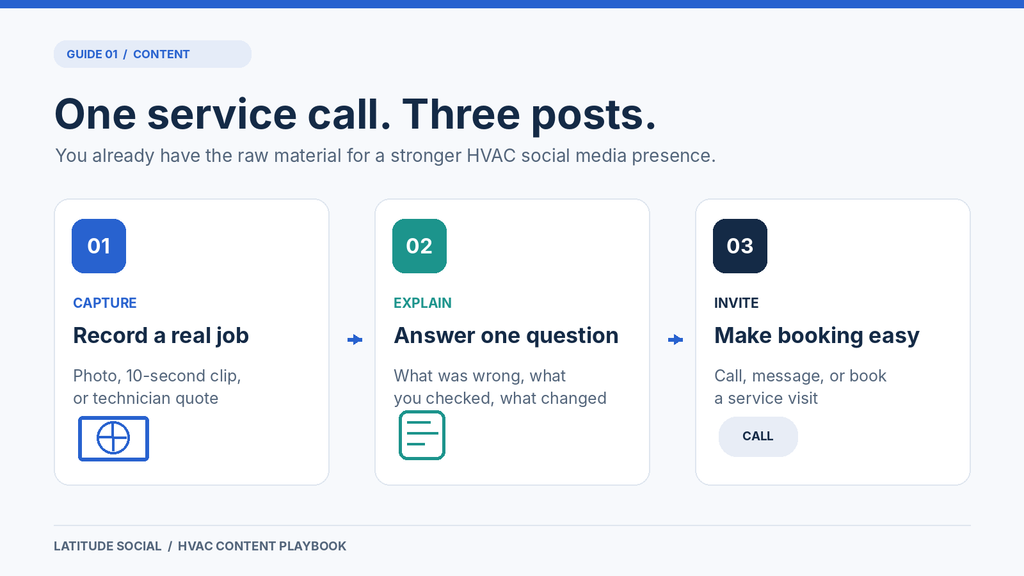
1. Capture Something From the Job
You don’t need a professional video crew.
Ask technicians to capture a few useful moments when appropriate:
- A dirty air filter beside a clean replacement.
- An old outdoor unit before a replacement.
- A completed HVAC installation.
- A technician explaining a maintenance check.
- A short video showing the equipment being inspected.
Get customer permission when needed, and avoid showing private property details, addresses, or personal information without approval.
2. Explain Why It Matters
A photo of an air conditioner doesn’t tell homeowners very much.
A photo accompanied by an explanation of what your technician discovered is far more useful.
Instead of writing:
“Another AC repair completed!”
Try:
“An air conditioner that keeps turning on and off may be signaling a problem. Here’s what our technicians check when a homeowner reports short cycling.”
Now you’re answering a question someone might genuinely have.
The same principle works in other home-service industries. Our article on how to market a roofing company explores how making professional work visible can build customer confidence.
3. Give Homeowners a Clear Next Step
Not every post needs a sales pitch, but people should understand how to reach you.
Useful calls to action include:
- “Save this tip for your next maintenance visit.”
- “Not sure what’s causing the issue? Send us a message.”
- “Visit our website to request an appointment.”
- “Serving homeowners throughout our local service area. Contact us to discuss your system.”
The goal of HVAC social media marketing is to make contacting your company feel like a natural next step, not an aggressive sales push.
Which Platforms Are Best for HVAC Social Media Marketing?
You don’t have to maintain five different accounts to attract local customers.
In most cases, starting with Facebook and Instagram is a practical choice for residential HVAC companies. Google Business Profile can complement those platforms by reaching people who are already searching for services.
Here’s how to use each.
Facebook: Reach Local Homeowners and Build Familiarity
Facebook is useful for explaining services, sharing reviews, publishing seasonal reminders, and engaging with local communities.
Good Facebook content includes:
- Photos of recent jobs.
- Customer testimonials.
- Heating and cooling maintenance tips.
- Seasonal appointment announcements.
- Short educational videos.
Paid advertising can extend your reach, but your organic content should still make your business look active and credible.
For a related example of how local service businesses reach nearby homeowners, see our guide to landscaping Facebook ads.
Instagram: Show the People and Work Behind Your Company
Instagram is especially useful for visual proof.
Use Reels, carousels, and photos to show what your technicians actually do.
A 15-second clip of a technician explaining a common problem can introduce your company more naturally than another stock image of an air conditioner.
Focus on clear visuals, understandable explanations, and recognizable branding.
Google Business Profile: Support Local Search Visibility
Google Business Profile isn’t a traditional social platform, but it deserves a place in your content routine.
A complete profile helps homeowners find your contact details, services, reviews, and business information through Google Search and Maps.
You can also publish updates about seasonal services, promotions, and company news. Google explains these options in its Business Profile posting guide.
For HVAC social media marketing, the simplest approach is to reuse relevant content across channels while adapting the caption and call to action for each platform.
Don’t copy everything blindly. Make sure every post fits the audience and the features of the platform where it appears.
Your 4-Week HVAC Social Media Marketing Calendar: 8 Posts That Serve a Purpose
You don’t need to publish daily to create a useful presence.
Start with two quality posts per week. That gives you eight posts across four weeks, enough to cover common customer questions, show completed work, introduce your team, and promote relevant services.
This HVAC social media marketing calendar is designed around a simple principle:
Educate first, build trust consistently, and make booking easy.
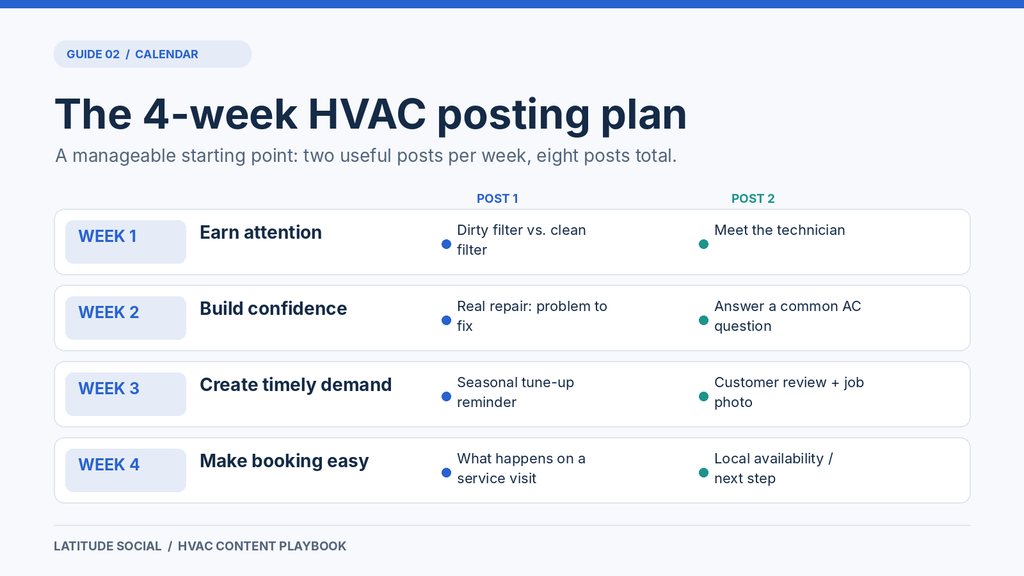
Week 1: Get Homeowners to Notice Your Content
Start with something homeowners recognize and understand.
The first week of your HVAC social media marketing plan should make people stop scrolling because the topic feels relevant.
Post 1: The Dirty Filter Comparison
Format: Before-and-after photo or short Reel.
Show a real used filter beside a clean replacement. Explain how a dirty filter can restrict airflow and why homeowners should check their filters according to their equipment’s requirements.
Example caption:
“Does your air filter look like this? A clogged filter can restrict airflow and make your system work harder. Checking it regularly is one of the simplest ways to care for your HVAC system. Save this reminder for later!”
Post 2: Meet the Technician
Format: Team photo or short introduction video.
Introduce someone who works inside customers’ homes.
Share their role, experience, or favorite part of the job.
Example caption:
“Meet one of the people behind our service calls! Our technicians do more than repair equipment. They explain what they find and help homeowners understand their options. We’re proud of the team that represents our company every day.”
This kind of content helps turn an unfamiliar business into a recognizable local team.
Week 2: Show Why Customers Can Trust You
Your second week should demonstrate real expertise.
This is where HVAC social media marketing moves beyond general awareness and begins helping people evaluate your services.
Post 3: From Problem to Solution
Format: Photo carousel showing a real completed job.
Use three slides:
- The problem the homeowner reported.
- What your technician found.
- The completed work and next steps.
Example caption template:
“We recently visited a home in [Neighborhood] after the homeowner noticed [verified problem]. Our technician identified [finding] and completed [documented service]. Here’s a look at the work and what the homeowner needed to know.”
Use details from a real service visit rather than inventing a repair story.
If you need more ways to communicate the value of your work, explore our article on HVAC services marketing.
Post 4: Answer a Question Homeowners Actually Ask
Format: Educational carousel or 20-second video.
Choose a question your technicians hear frequently.
For example:
“Why does my AC keep turning on and off?”
Example caption:
“An AC that switches on and off frequently may need attention. Several issues can contribute to short cycling, from airflow restrictions to equipment problems. If your system is doing this repeatedly, our team can help inspect it and identify the cause.”
Notice what makes this effective: you’re providing useful context without pretending to diagnose a system through a social media post.
Week 3: Connect Your Content to Seasonal Demand
Heating and cooling needs change with the weather.
Your HVAC social media marketing should reflect what homeowners are likely thinking about before each busy season.
Post 5: The Seasonal Maintenance Reminder
Format: Branded graphic, service photo, or short video.
Before warmer weather, focus on cooling-system preparation. Before colder weather, shift toward heating-system maintenance.
ENERGY STAR recommends scheduling cooling checkups in spring and heating checkups in fall. You can reference its maintenance checklist when planning educational content.
Example caption:
“Don’t wait for the first really hot day to think about your AC. Scheduling a pre-season checkup gives you an opportunity to have your equipment inspected before the busiest cooling months. Contact our team to learn about our maintenance services.”
This also creates an opportunity to introduce recurring maintenance options.
Our guide to HVAC maintenance plan marketing explains how to turn routine service into stronger, longer-lasting customer relationships.
Post 6: Let a Happy Customer Speak
Format: Review graphic with a real job photo.
Choose an authentic review that mentions a meaningful part of the experience, such as communication, professionalism, punctuality, or a clear explanation.
With the customer’s permission where required, pair the review with a relevant image.
Keep the original meaning intact.
You can add a brief introduction such as:
“We appreciate customers who take the time to share their experiences. Here’s what one homeowner had to say about working with our team.”
A genuine review often communicates trust more effectively than a broad claim that your company provides the best service.
Week 4: Give Interested Homeowners a Reason to Contact You
By now, your audience has seen useful advice, completed work, and proof that your company is active.
The final week of your HVAC social media marketing calendar should remove uncertainty about the booking process.
Post 7: What Happens During a Service Visit?
Format: Educational carousel.
Show homeowners what they can generally expect when scheduling service with your company.
Explain the arrival process, initial assessment, communication, and next steps. Only describe procedures your business actually follows.
Example caption:
“Not sure what to expect when you book an HVAC service visit? We start by listening to the problem you’re experiencing, inspect the relevant equipment, and explain what we find. Our goal is to help you understand your options before moving forward.”
Post 8: The Local Service Reminder
Format: Branded service-area graphic or team photo.
Remind people where you operate and how they can get in touch.
Example caption:
“Need heating or cooling service in [City]? Our team helps local homeowners with AC repairs, system maintenance, and installations. Visit our website or send us a message to discuss the service you need.”
A Simple Formula for Better HVAC Social Media Captions
For any of these eight posts, try this structure:
Hook → Helpful information → Local relevance → Clear next step
For example:
“Is your AC struggling to keep up? Several issues can affect cooling performance, and the right fix depends on the cause. We help homeowners throughout [City] understand their options. Contact us to schedule an inspection.”
This structure makes your HVAC social media marketing more useful because it addresses a recognizable problem before asking for business.
How to Turn HVAC Social Media Marketing Into Actual Service Calls
Publishing content is only the beginning.
You can have a useful Instagram account, attractive graphics, and an active Facebook page and still miss potential customers if they can’t easily contact you.
Successful HVAC social media marketing needs a clear path from discovery to booking.
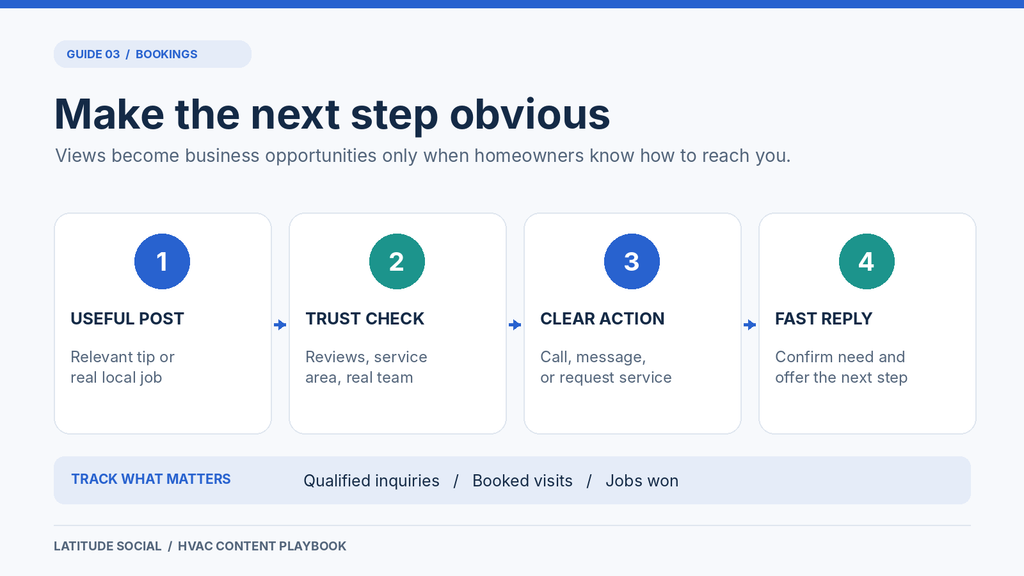
Make Your Profile Easy to Understand
Imagine someone discovers your business through a Reel and visits your profile.
Can they immediately figure out:
- What HVAC services you provide?
- Which cities or neighborhoods you serve?
- How to call your office?
- Where to request an appointment?
- Whether your business handles residential, commercial, or both types of work?
If those answers are difficult to find, even valuable content may not turn into an inquiry.
Give Each Post One Primary Call to Action
Don’t ask people to like, share, comment, follow, visit your website, and call your office all in the same caption.
Choose the action that best fits the content.
Educational post? Encourage people to save it.
Service explanation? Invite questions.
Seasonal appointment announcement? Direct homeowners to your booking page or phone number.
A clear action is easier to understand and act on.
Follow Up With People Who Request Information
Someone who sends a message about an AC repair has already taken an important step.
Your response matters.
A useful first reply might ask what issue they’re experiencing, where they’re located, and how to reach them to arrange service.
If they request an estimate, explain the next step and follow up appropriately.
This is similar to what we explain in our roofing estimate follow-up guide: generating interest is only valuable when customers receive the information they need to make a decision.
Social media shouldn’t replace your service process. It should help more homeowners enter that process.
Should HVAC Companies Use Facebook Ads?
Organic content and paid advertising serve different purposes.
Organic HVAC social media marketing helps you create a consistent presence, share expertise, and remain familiar to your audience.
Facebook and Instagram ads allow you to pay to distribute a specific message to a defined audience.
For example, an HVAC company might advertise:
- Pre-season cooling-system maintenance.
- Heating inspections before colder weather.
- Installation consultations.
- A clearly explained, legitimate seasonal offer.
The key is to promote a service with a specific goal.
Start With One Service and One Audience
Instead of advertising every service your company provides, choose one.
For example, promote AC tune-ups to people within the geographic area your business serves.
Use a real photo or video, explain the service, and send interested homeowners to a relevant booking page or contact form.
Make sure your audience settings, ad creative, and lead process match the service you want to sell.
The same local-advertising principle applies to roofing contractors. Our guide to Facebook ads for roofers covers how geographic targeting, relevant offers, and follow-up affect campaign performance.
Don’t Judge Ads by Cheap Clicks Alone
A campaign that generates hundreds of clicks but no qualified service inquiries isn’t necessarily successful.
Measure what happens after someone clicks.
Did they contact the company? Were they inside the service area? Did they book an appointment? Did the appointment turn into a completed job?
A useful HVAC advertising campaign should be evaluated against actual business outcomes, not just engagement.
How to Measure HVAC Social Media Marketing Results
A post with 20 likes can be valuable if it helps the right homeowner discover your company.
A post with thousands of views may contribute little if it reaches people outside your service area who will never hire you.
That’s why HVAC social media marketing performance should be measured in stages.
| Metric | What it tells you |
|---|---|
| Reach | How many people are seeing your content |
| Engagement | Whether people find your posts interesting or useful |
| Profile visits | Whether content encourages people to learn about your company |
| Website clicks | Whether people take the next step |
| Qualified inquiries | How many relevant potential customers contact you |
| Booked appointments | How many inquiries turn into scheduled visits |
| Completed jobs | How many appointments result in actual business |
Track Where Your Service Inquiries Come From
A simple question can help:
“How did you hear about us?”
Record the answer when a new customer contacts your company.
You can also use tracked website links, campaign-specific contact forms, and advertising reports to better understand which activities generate inquiries.
Keep in mind that not every customer will remember exactly where they first discovered you. Attribution is useful, but it isn’t always perfect.
Don’t Forget Existing Customers
Some of the most valuable people following your HVAC company are customers you’ve already served.
They may need another repair, future maintenance, a system upgrade, or help at a second property.
They may also recommend you to a neighbor.
Staying visible supports those relationships. It’s a principle that extends beyond HVAC, as we discuss in our guide to landscaping customer retention.
Your social media content shouldn’t only ask, “How do we find new customers?”
It should also ask, “How do we make it easy for satisfied customers to remember us?”
HVAC Social Media Marketing FAQs
How Often Should an HVAC Company Post on Social Media?
For small HVAC companies, two quality posts per week can be a manageable starting point.
The right frequency depends on your available content, audience response, and business goals.
With HVAC social media marketing, it’s better to maintain a realistic schedule than to publish daily for two weeks and disappear for a month.
Start with eight posts per month, evaluate the results, and increase frequency if you have the resources and a reason to do so.
What Are the Best Social Media Post Ideas for HVAC Companies?
Some of the most useful HVAC social media marketing ideas include real project photos, technician introductions, seasonal maintenance reminders, answers to customer questions, and authentic testimonials.
Focus on topics that help homeowners understand a problem, trust your expertise, or know when to contact your company.
Is Facebook or Instagram Better for HVAC Marketing?
Both can support HVAC social media marketing, but the right choice depends on your audience.
Facebook can be useful for local homeowner engagement, reviews, updates, and advertising. Instagram is well suited for short videos, project photos, and behind-the-scenes content.
If you’re unsure where to start, maintain a professional presence on both, test different content formats, and use actual inquiries to guide your priorities.
What Should an HVAC Company Post During the Slow Season?
The slower months are a good time to share preventive maintenance advice, explain common equipment problems, highlight installations, answer frequently asked questions, and introduce your technicians.
HVAC social media marketing during quieter periods helps maintain brand familiarity without depending entirely on emergency demand.
You can also create and schedule content before the next busy season, when your team may have less time to focus on marketing.
Can Social Media Actually Generate HVAC Leads?
Yes, social media can generate HVAC inquiries through profile visits, messages, website clicks, and paid campaigns.
However, posting doesn’t guarantee booked jobs.
Effective HVAC social media marketing depends on reaching relevant homeowners, providing useful content, demonstrating credibility, and making it easy to request service.
The strongest approach connects social media activity with a reliable customer response and booking process.
Make HVAC Social Media Marketing One Less Thing on Your Schedule
Running an HVAC company is already a full-time job.
Between service appointments, dispatching technicians, answering calls, and keeping customers happy, creating social media content can quickly become another unfinished task.
But staying visible doesn’t have to mean spending hours writing captions or designing graphics.
A simple, consistent approach can help your company share its expertise, build local awareness, and give potential customers more reasons to remember your business.
At Latitude Social, we help small businesses maintain a professional social media presence without adding more work to their schedules.
Our social media management plans start at $99 per month for eight posts, with professionally created, branded content designed around your business.
Whether you’re sharing useful heating and cooling advice, highlighting your technicians, or showcasing your latest installations, we’ll help you keep your content consistent.
Your team handles the heating and cooling. We’ll help you keep your business visible.